
Sync Setup - Apple Logic Pro on a separate computer
About DAW Sync
To play video in sync with Logic Pro, Video Sync needs a way to follow the Logic Pro transport - knowing when it plays, stops, and where the playhead is located at any moment. This connection between Video Sync and Logic Pro is called DAW sync.
About This Configuration
This chapter covers setting up DAW sync with Apple Logic Pro running on a separate computer from Video Sync. The setup uses network MIDI connections via Apple's Audio MIDI Setup to establish MTC (MIDI Timecode) and MMC (MIDI Machine Control) links between the two computers.
Note: The following explanation and screenshots are related to Logic Pro version 11, but the steps will be similar for other versions.
Understanding MTC and MMC
This chapter covers setting up two MIDI-based protocols that work together to provide synchronised playback:
MTC (MIDI Timecode) transmits a continuous stream of timecode on a dedicated MIDI port during playback, allowing Video Sync to track the current position and play at the correct speed.
MMC (MIDI Machine Control) sends transport commands and locate messages on a separate dedicated MIDI port. When navigating to a specific timecode position in Logic Pro (such as clicking in the timeline or using markers), MMC sends locate commands to update Video Sync's position without requiring playback.
Setup
The easiest way to provide Video Sync with incoming MTC/MMC data from another computer, is to setup a network MIDI connection using Apple's built-in Audio MIDI Setup tool to transmit all the MIDI data between the two computers. It is usually not necessary to buy a separate MIDI interface and cables to connect the MTC sending and receiving computers, although a cabled MIDI connection can be used if preferable. Since MIDI was developed in the 80s, it has a really low data rate. Therefore it should not be a problem to use network MIDI in a Wi-Fi environment.
Note: A cabled ethernet network connection is the preferred method for reliability.
The following instructions assume that you have two Apple Macs: one with Video Sync; the other with Logic Pro.
Note: Although not listed as a separate DAW Sync Setup Option, this Network MIDI setup incidentally also works flawlessly with Video Sync on the same computer.
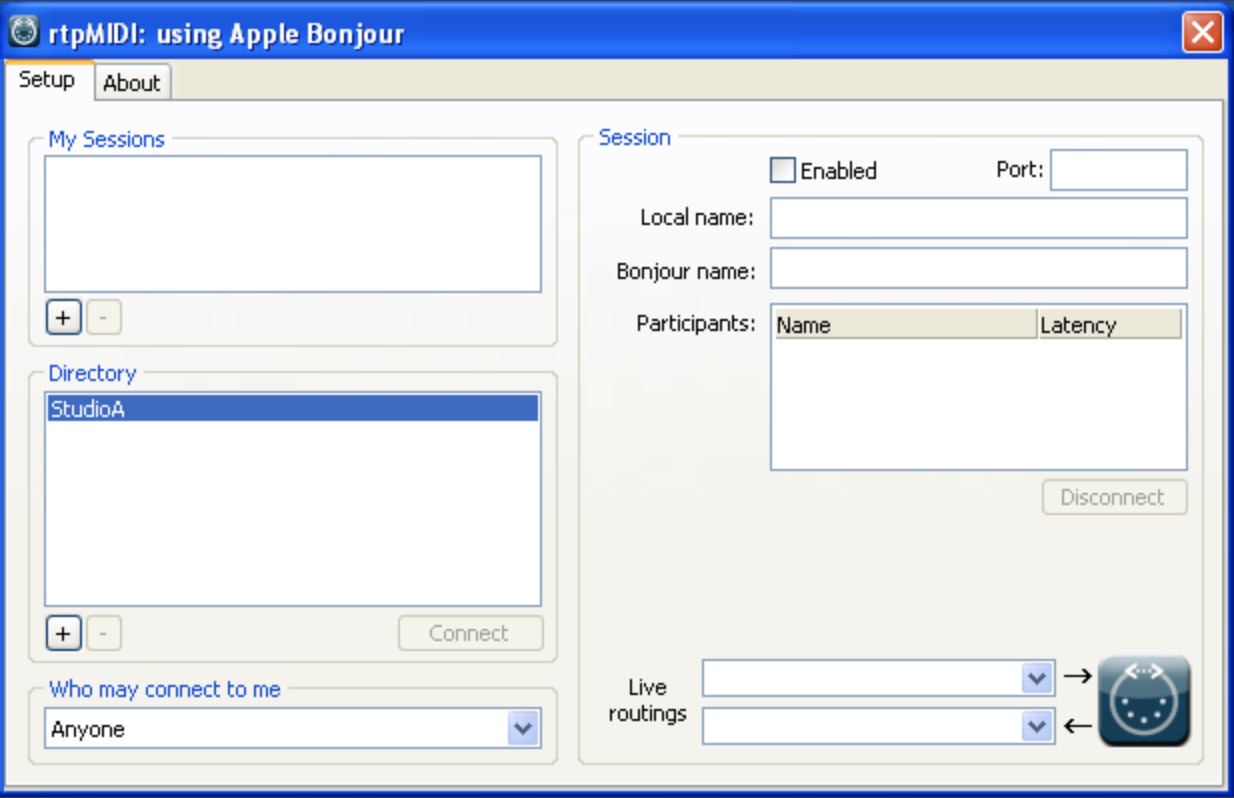
If the Logic Pro computer is a PC, rtpMIDI is a free PC equivalent to Apple's network MIDI implementation. Download & setup instructions can be found here: http://www.tobias-erichsen.de/software/rtpmidi.html
Our thanks to Tobias Erichsen for this invaluable tool.
Configuring Audio MIDI Setup on the Logic Pro computer to send MTC & MMC over the Network
On the Logic Pro computer, go to Applications → Utilities & open Audio MIDI Setup. The MIDI Network Setup window should appear:
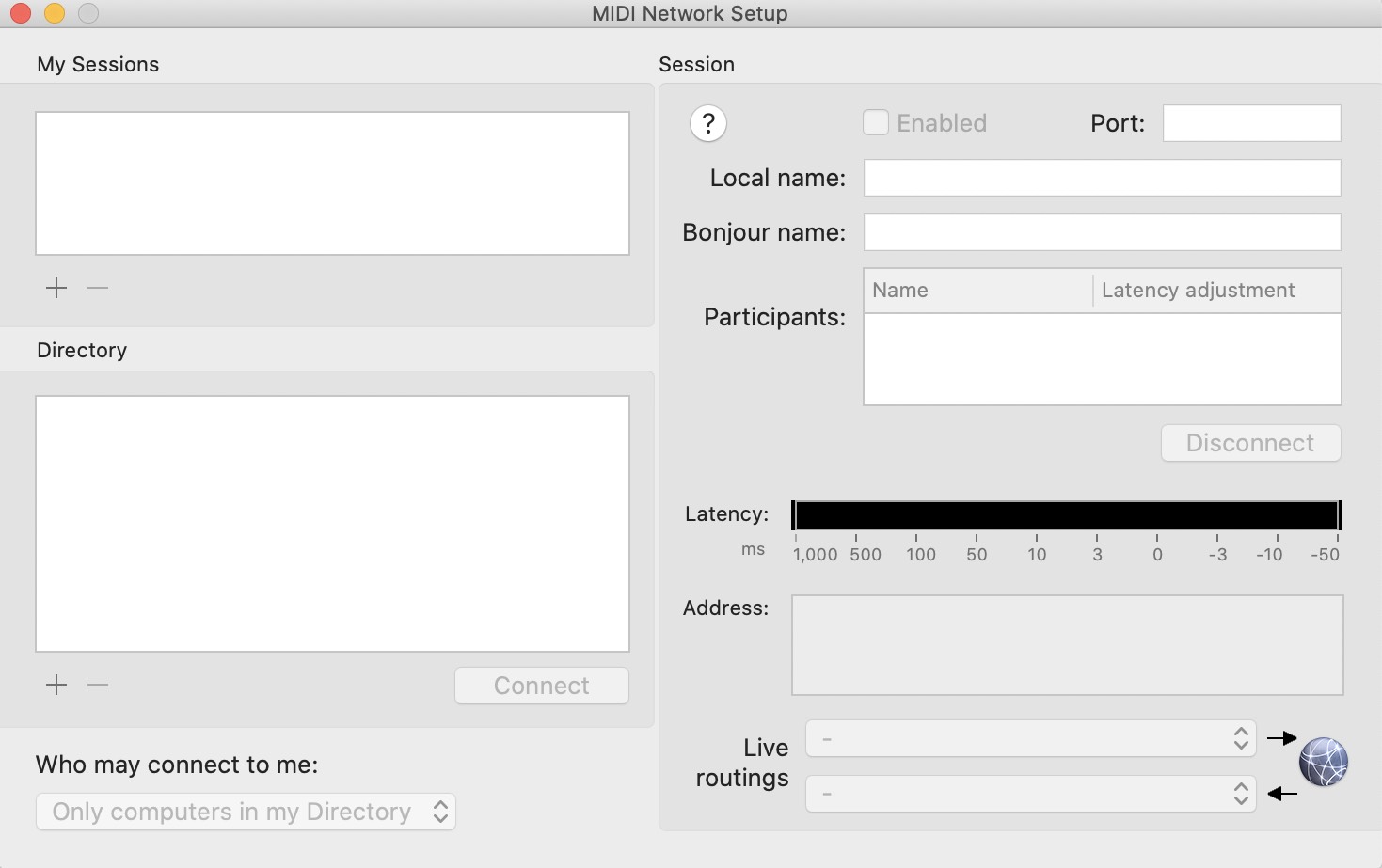
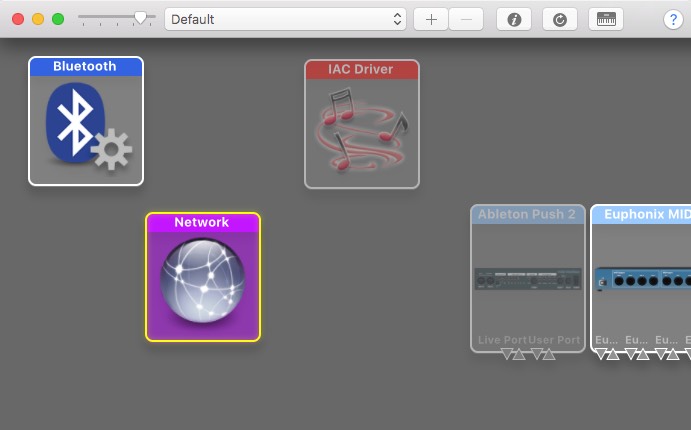
If the window is not shown, select Window → Show MIDI Studio & then from the MIDI Studio menu that appears, select Open MIDI Network Setup.
In older versions of Audio MIDI Setup where this option is not present, it can be accessed by double-clicking the Network device icon in the default MIDI Studio window.
In the My Sessions field top left, create a new session by clicking +.
Click the checkbox to the left of the name to enable the session.
Rename it (computer 1 name) MTC/MMC Send (or something similar) - e.g. MacProHDX MTC/MMC Send. This name will automatically be copied to the Local name field.
Note: The Local name is the name that appears on this local computer.
Copy this name & paste it in the Bonjour name field.
Note: The Bonjour name is the name that is displayed on the other computers in the network.
Although a session can be used in either input or output directions, to avoid confusion it is recommended to stick to one direction by noting this in the session name, e.g. Send or Out.
MTC & MMC do not require separate Network sessions made for each - they can share the same session.
Set the Port: field to 5004.
Select Anyone in the Who may connect to me dropbox on the bottom left.
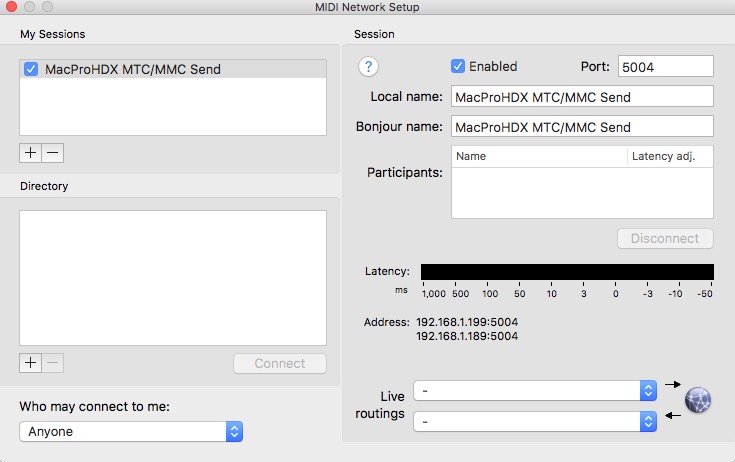
Configuration is complete for the Logic Pro computer. This should not need to be set up again in future.
Configuring Audio MIDI Setup on the Video Sync computer to receive Network MTC & MMC
On the Video Sync computer, close Video Sync & open Audio MIDI Setup. Open the MIDI Network Setup window as described above. The Logic Pro computer should be visible in the Directory field - showing (computer 1 name) MTC/MMC Send with a green active circle to the left.
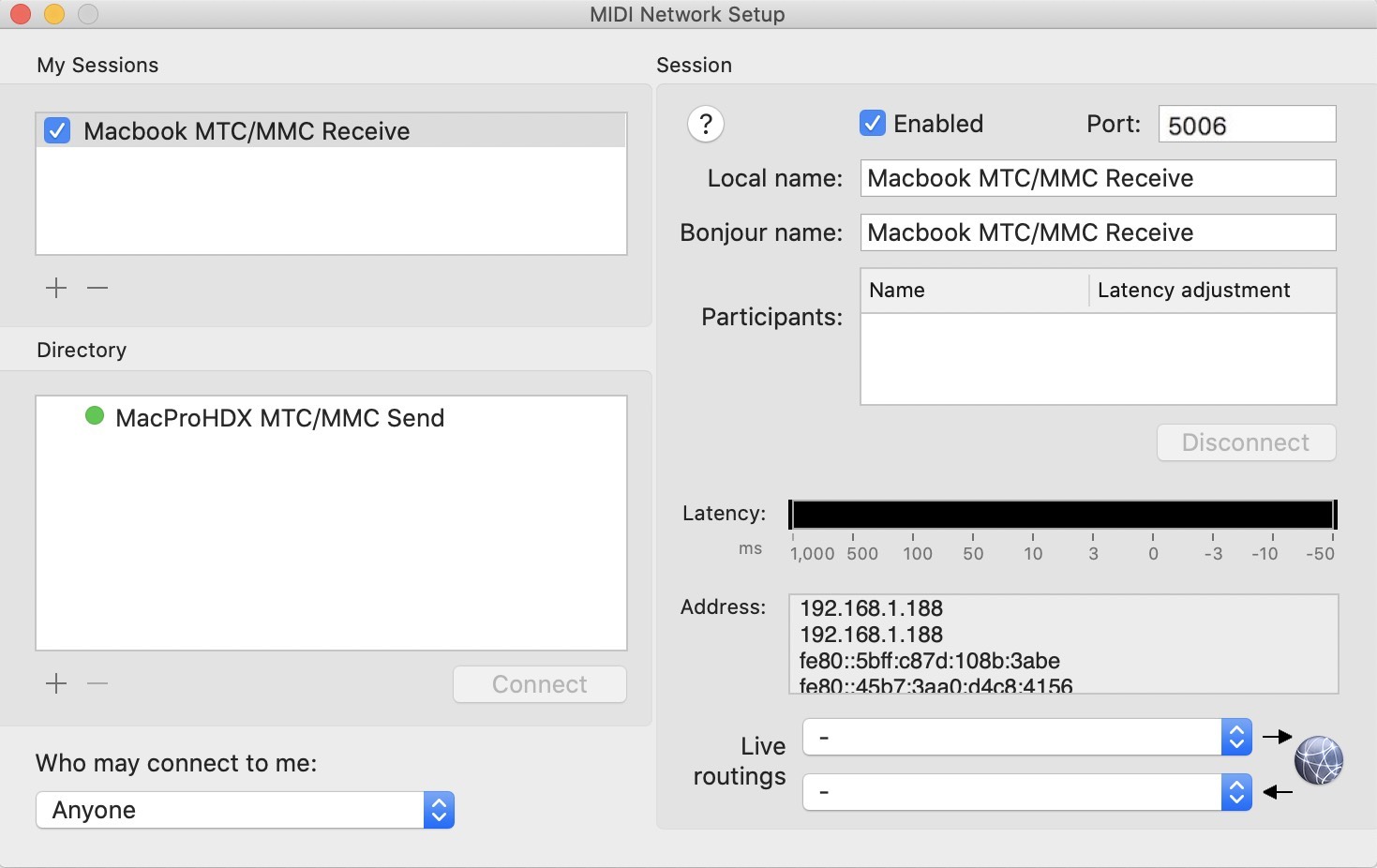
In the My Sessions field top left, create a new session by clicking +.
Click the checkbox to the left of the name to enable the session.
Rename it (computer 2 name) MTC/MMC Receive (or something very similar) - e.g. MacbookPro MTC/MMC Receive.
This name will automatically be copied to the Local name field.
Copy this name & paste it in the Bonjour name field.
Set the Port: field to 5006.
Select Anyone in the Who may connect to me: selection field on the bottom left.
Connecting the Network MTC/MMC Sessions
Now that the two Sessions have been created, the next step is to connect them.
Note: The steps until this point should not need to be done again in future. The following simple steps to connect only need to be done once every time the computers are restarted.
With the (computer 2 name) MTC/MMC Receive session selected in the My Sessions box, select (computer 1 name) MTC/MMC Send in the Directory field, and hit the Connect button.
(computer 1 name) MTC/MMC Send should now appear in the Participants: field on the right.
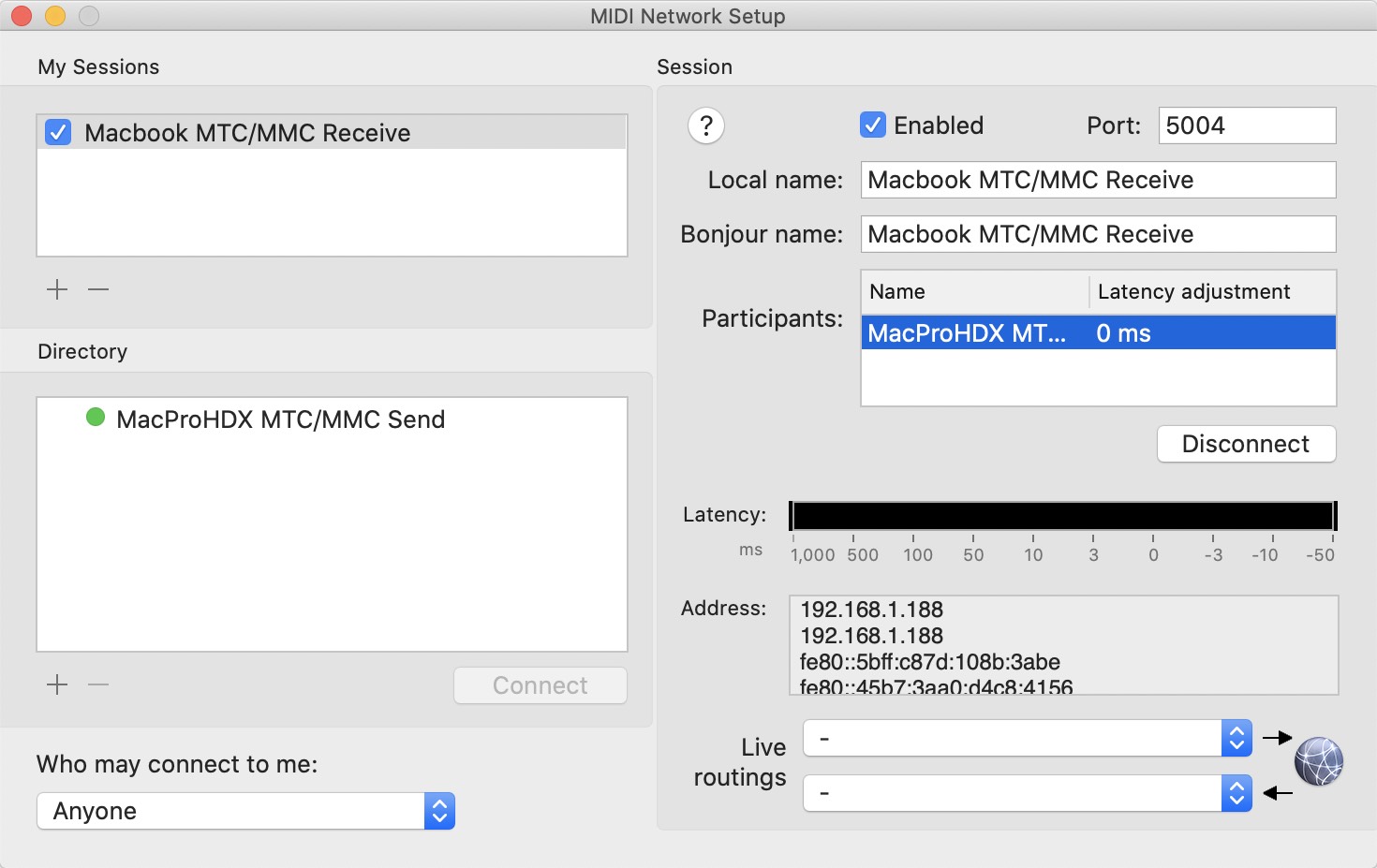
Note: Regardless of which computer is chosen to Connect, only one of the computers needs to connect to establish the connection.
On the Logic Pro computer, (computer 2 name) MTC/MMC Receive should now also be seen in the Participants: window.
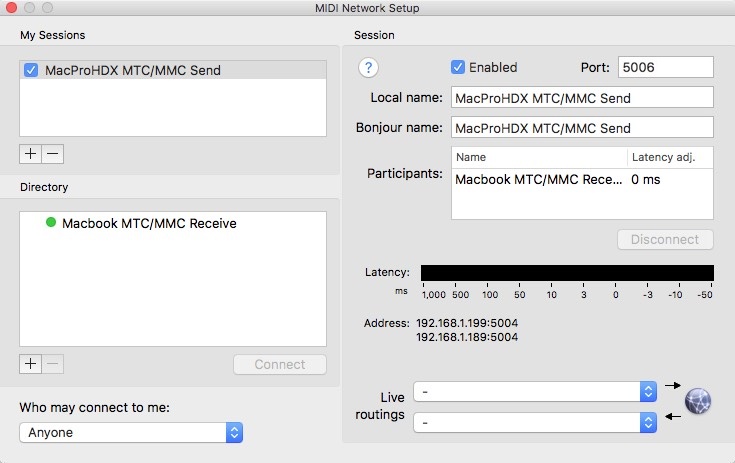
If the (computer 2 name) MTC/MMC Receive session does not show up in the Directory list, try re-launch Audio-MIDI-Setup.
Video Sync MTC / MMC Setup
Launch Video Sync.
Note: If Video Sync was open already, use the Rescan Available MIDI Ports button in the SYNC preferences.
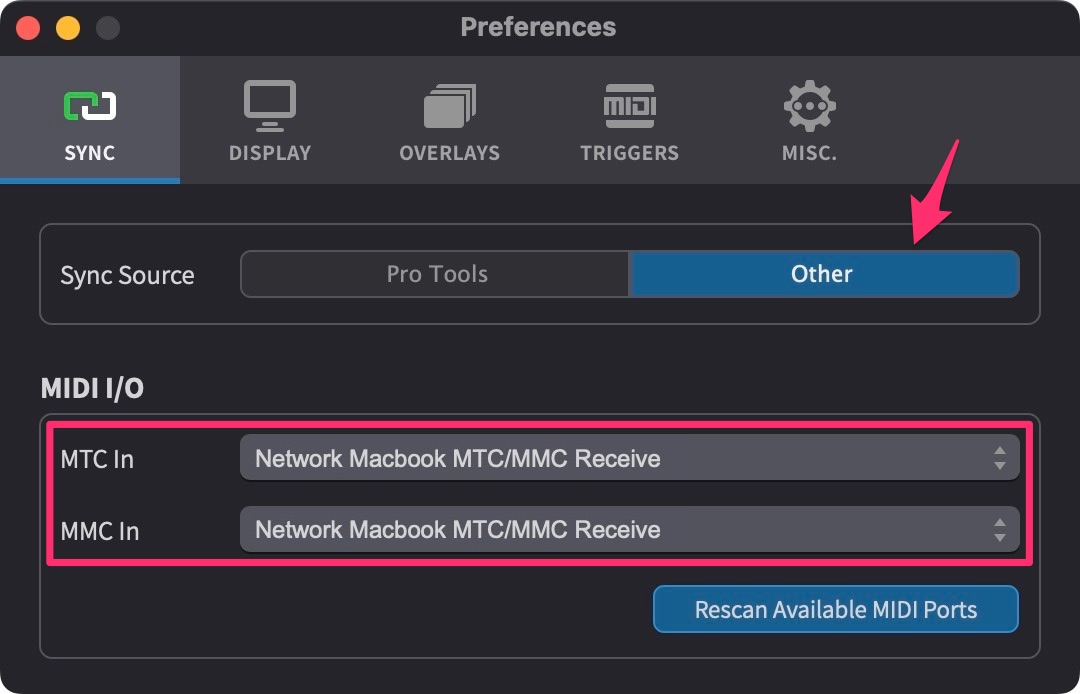
To show the MIDI I/O options in Video Sync, first navigate to the SYNC tab of the Preferences / Settings window.
Set the Sync Source field to *Other
Next, select Network (computer 2 name) MTC/MMC Receive in both the MTC In & MMC In fields, as per the image below:.
Logic Pro Network MTC (MIDI Timecode) Setup
With a project opened, go to File → Project Settings → Synchronization → MIDI tab
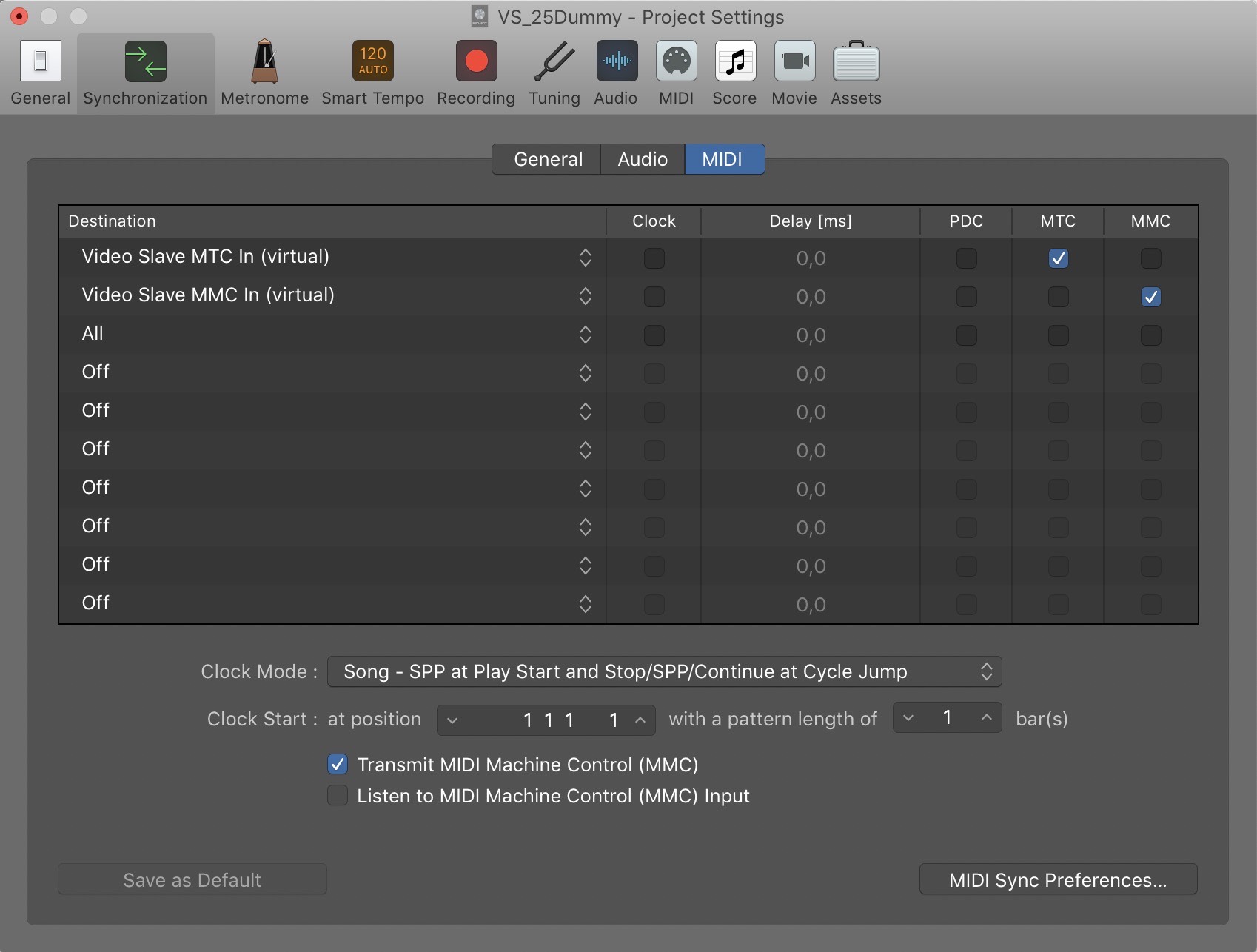
In the first unused row, select (computer 2 name) MTC/MMC Receive (in our example named Network Macbook MTC/MMC Receive) & enable MTC.
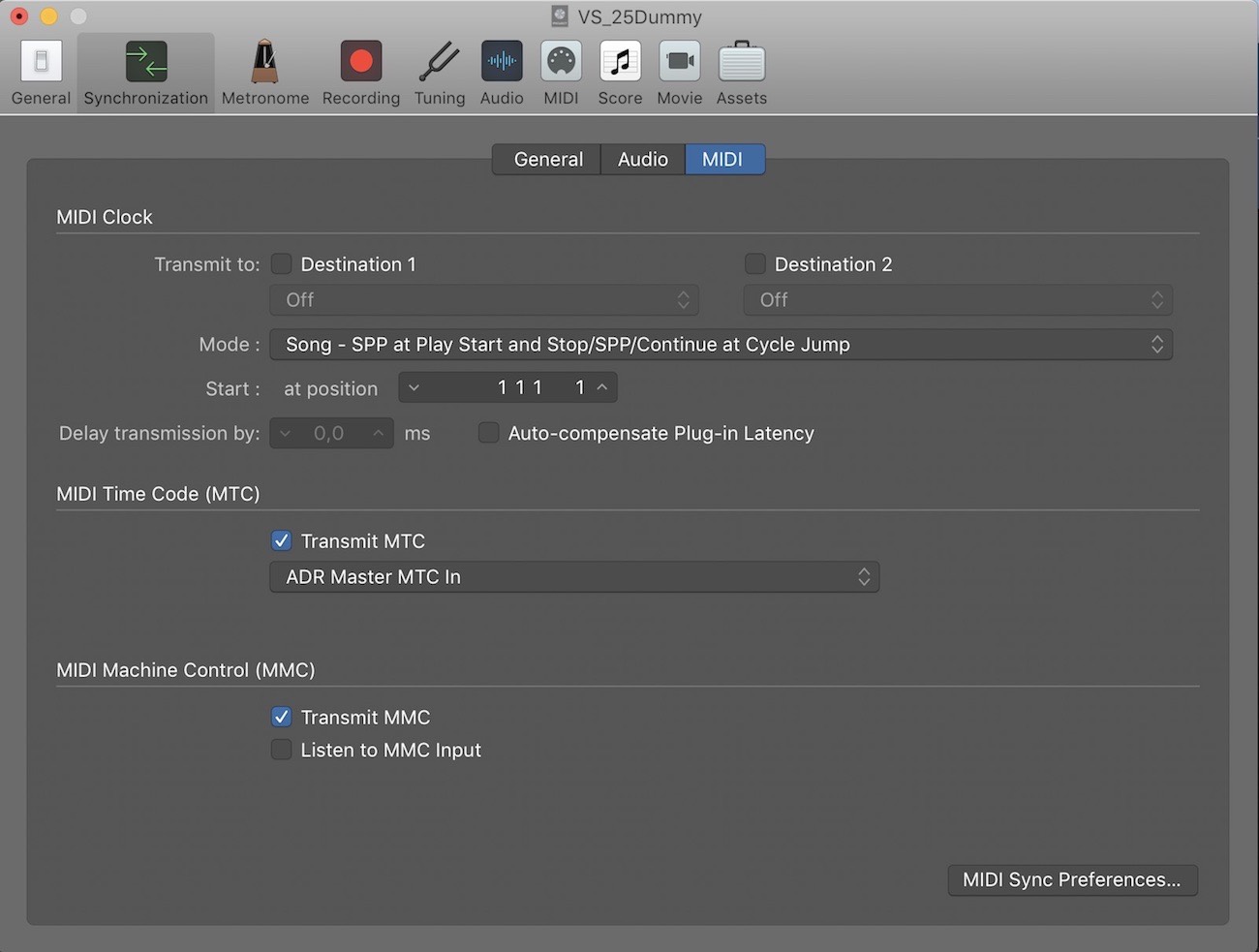
For versions of Logic Pro prior to version 11, this window appears differently - with the same corresponding settings.
Enable the Transmit MTC checkbox and select (computer 2 name) MTC/MMC Receive (in our example named Network Macbook MTC/MMC Receive) from the dropdown menu underneath.
Ensure that the option Listen to MIDI Machine Control (MMC) Input is not enabled.
Logic Pro Network MMC (MIDI Machine Control) Setup
Still in File → Project Settings → Synchronization → MIDI tab, in the first unused row, select (computer 2 name) MTC/MMC Receive (in our example named Network Macbook MTC/MMC Receive) & enable MMC.
Note: For network MIDI or ipMIDI, it is possible to use the same port for both MTC and MMC, so check both boxes in the same line.
Note: Logic Pro has a limitation in its MIDI Machine Control implementation where it does not transmit timecode position updates when dragging regions in the timeline. As a result, Video Sync will not receive positional information during region dragging operations, and the video position will not update until playback begins or another MMC locate command is sent.
For versions of Logic Pro prior to version 11, this window appears differently - with the same corresponding Transmit MMC setting enabled as follows:
Matching Frame Rates
For MTC sync to work correctly, the Logic Pro project frame rate must match the timeline frame rate in Video Sync.
In the TIMELINES tab, locate the active timeline and check its frame rate in the summary section. If video is present on the timeline, the frame rate is derived from the video file. If no video is present, the frame rate can be set manually by clicking the pencil icon next to the timeline name and selecting the required frame rate from the TC Frame Rate menu.
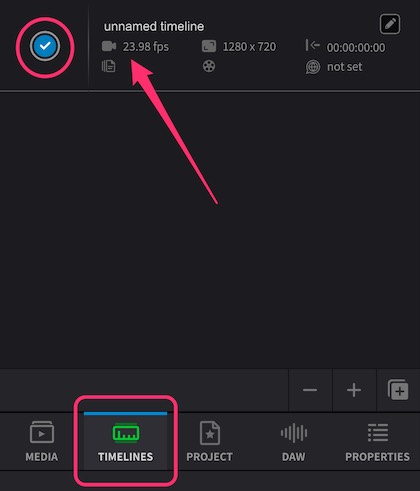
Ensure your Logic Pro project is set to the same frame rate as the Video Sync timeline.
Enabling Synchronised playback
When hitting play or scrubbing within Logic Pro, both the incoming timecode field should now be seen incrementing & the timecode rate displayed within the Incoming TC section to the left of the main timecode counter in Video Sync.
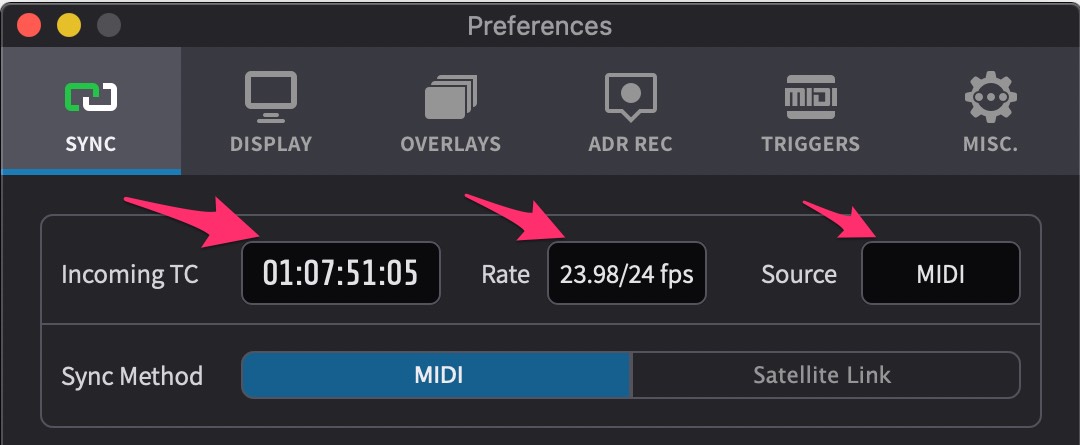
If the Sync button to the left of the transport buttons isn't already blue, click on it to activate it to follow external sync.
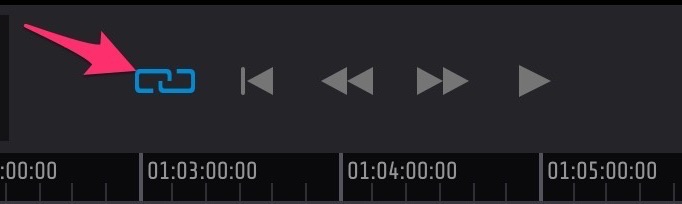
Video Sync MTC/MMC sync is now online & ready to go. Hit play in Logic Pro and Video Sync will play back in sync.
High Frame Rate Content
Video Sync supports timelines running at up to 60 frames per second. However, MTC was designed around SMPTE broadcast standards and only supports frame rates up to 30fps (24, 25, 29.97, and 30). The specification has never been updated to include higher frame rates.
To sync high frame rate timelines via MTC, set the Logic Pro project frame rate to half the timeline frame rate. For example:
- 48fps timeline → set Logic Pro to 24fps
- 50fps timeline → set Logic Pro to 25fps
- 60fps timeline → set Logic Pro to 30fps
Video Sync will automatically match the incoming timecode at half its frame rate.
Troubleshooting
If incoming timecode is not showing in Video Sync:
- Check that MTC generation is enabled in Logic Pro
- Check that the correct MTC port is selected in Logic Pro's synchronization/MIDI settings
- Ensure Video Sync was launched before Logic Pro so the virtual ports are available (if using virtual ports)
If incoming timecode is showing but playback is not syncing:
- Ensure the Sync button is enabled (blue) in Video Sync
- Check that frame rates match (see Matching Frame Rates above)
- Check that timecode ranges match - if the Logic Pro session starts at 01:00:00:00 but the Video Sync timeline starts at 10:00:00:00, playback will not begin until Logic Pro reaches 10:00:00:00
If Video Sync's position only updates during playback but not when navigating in Logic Pro:
- This indicates an issue with MMC (MIDI Machine Control) setup
- Check that the correct MMC port is selected in Video Sync
- Check that MMC is enabled and configured correctly in Logic Pro
If playback is jumpy or frames are being skipped:
- This is often caused by mismatched frame rates between Logic Pro and Video Sync - ensure both are set to the same frame rate (see Matching Frame Rates above)
- Try increasing the TC Freewheel value in Preferences → MISC. This defines a number of freewheel frames to keep playback running through unexpected timecode values. Note that higher values will make Video Sync less responsive to external timecode changes.
If synchronised playback still does not work after following these steps, please contact support@non-lethal-applications.com.